Monday, March 5, 2012

A week in the life... at ARA, Boston

Sundays

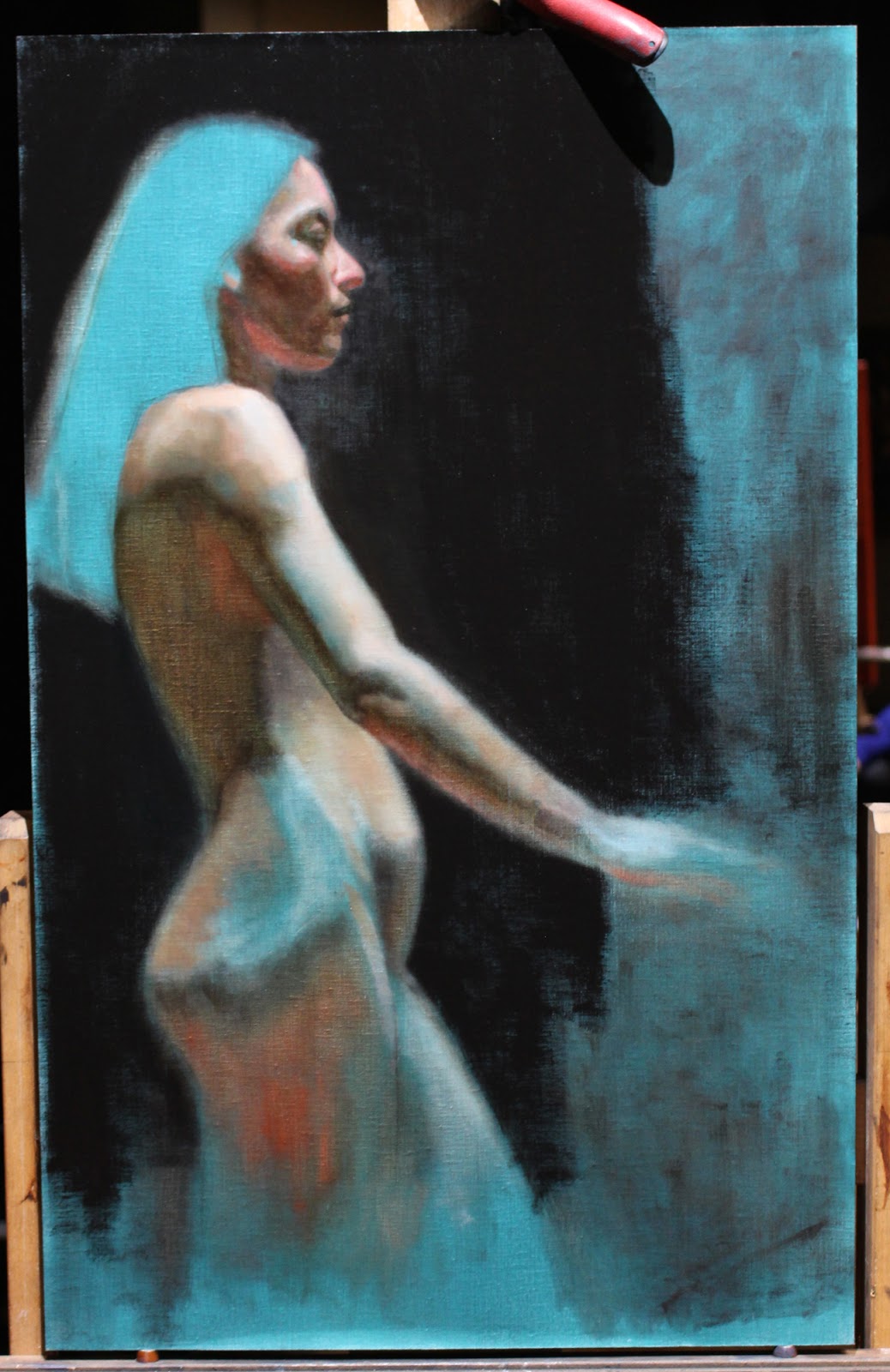
This term we moved out Figure Construct Drawing class to Sundays and today was our last session.


This eight week course centers on figure block-ins. Using our comparative measuring system, students concentrate on perfecting the larger proportions and capturing the gesture. The emphasis is on process (and not product!).


Due to popular demand, next term's class will return to Saturdays. We'll be meeting from 9:00am-12:00pm, April 14 - June 9 (no class May 26).

Thanks to everyone for a great winter term!

Sunday, February 19, 2012

Still Life Painting

There is a rarely found cult book on composition called The Painter's Secret Geometry by Charles Bouleau. This book is written to give a history to pictorial composition in paintings. This is called geometrical construction.  In the text Bouleau gets quite complicated in his analysis of some of the paintings - verging on the point of being incomprehensible.  At his best he talks more consisely about the golden ratio, rabatment, musical proportions (ratios of consonance) and aesthetic lines.Various artists I know have told me they think this book is a bit of a joke.  I found it interesting to read and I recommend you take a look at it if you can find it.

One of the compositional ideas discussed in the book is illustrated in a painting by Sanchez Cotan, Still-Life.  As you can see below the fruits and vegetables are placed on the arc of a circle which governs the composition.


Composition in still life painting is one of the subjects that will be covered in our summer still life painting workshop at the Academy of Realist Art, Boston.  Details are below.


Still Life Painting
August 20 – 31 10 days 10 am - 5 pm  Cost $1150
Instructor Brian MacNeil

Students will compose, set up and complete a still life painting. Learning topics will include still life composition, paint handling, lighting, and oil painting techniques and materials. Brian will share his experiences on still life painting and how to overcome common difficulties that may occur during the process.


Thursday, February 2, 2012

Paint like Peter Paul Reubens


In The Studio of Peter Paul Rubens
July 9 – 20 10:00 – 5:00 (10 days – Cost $1150)
Instructor - Garrett Vitanza
This workshop offers insight into the Flemish Baroque painter Peter Paul Rubens, his life and working methodology. Working from high resolution copies of some of Rubens’ paintings students will learn how to approach making a traditional oil painting. Students will be coached from the beginning drawing stage through to finished paint passages and work towards emulating the lush paint application of Rubens. For more information go to www.academyofrealistartboston.com 


Wednesday, January 25, 2012

Figure Painting in Oil - Workshop


We have just started finalizing the summer workshop schedule at the Academy of Realist Art, Boston.  We are happy to announce that Colleen Barry will be teaching figure painting in August. Colleen has shown her work in numerous exhibitions in the United States. She has studied widely with many notable instructors, bringing a wealth of knowledge to share with workshop participants. You can see more of Colleen’s work on her website www.colleenbarryart.com

Painting the Figure in Oil
August 6 – 17, 10 days 10 a.m. - 5 p.m. Cost $1150 (deposit $300)

Students will learn how to paint the figure in oil employing a limited palette. During the first week students will draw the figure in graphite to establish accurate proportions, shadow and light shapes and structure. Once this “cartoon” is transferred to canvas a thin under-painting will be made. In the second week of the workshop students will be taught the fundamentals of form, color and light. The use of a limited palette will aid students understanding of how to conceptualize form by narrowing down the color choices. The students will gain a more profound knowledge of how to synthesize the colors on the palette with the form and light on the model.

Tuesday, January 3, 2012

Portrait Painting in Oil


Portrait Painting in Oil
Part 2 – Painting
Painted by Brian MacNeil

This post is part 2 of a 2-part demonstration. For the drawing segment of this demonstration please see the previous blog. We begin this demonstration with the completed drawing “cartoon” from the previous post.


Transfer the Drawing - A canvas is covered with an imprimatura or “first coat” of thin paint. This can be done in various colors and values depending on the painting that will go on top of it. Here Brian has chosen a raw umber imprimatura that will be a good“beginning stage” generalization of his mid-value lights (halftones). On top of this imprimatura he has transferred the contour lines of his cartoon in paint. Here we can see an added benefit of preparing our drawing in straight-line segments. They are easily transferred to another surface and retain the most essential information we are trying to keep.


Dry Brush Drawing/Impasto in the Lights
– The shadow shape is generally indicated using just a smidge of paint and a limited number of shifts in value. These value shifts are used to draw in some of the shadow forms. The background is darker than the shadow and thus put in more thickly. The lightest portions of the head are put in with varying thicknesses of white paint giving a sense of volume. Thick paint is placed in the lightest/brightest areas and thinner paint is dragged where the lights darken as they turn away. This leaves us with a generally stated value structure for the painting.


Ebauche/Dead Coloring – In this stage the color notes are put in thinly. The shadows generally are warm and the halftones cool. Once the pinkish/red notes are added Brian will have a general color statement for the painting.


First Painting – This is the mosaic-like stage of the painting process. All the essential color and value notes are in, each of the major planes of the head have been broken down with patches that are used to roughly model the small forms.


Second Painting – In this stage Brian refines his portrait. This may be done using varying degrees of blending depending on the esthetic he is going for.  He has put the fabric in with a kind of  smooth transitional feel. In the flesh he has unified the modeling of the small forms but left them rough and flesh-like.

Saturday, December 31, 2011

Portrait Painting in Oil Demonstration


Portrait Painting in Oil
Part 1 Drawing
By Brian MacNeil

A 2-part painting demonstration prepared by Brian MacNeil. This outlines the drawing stages students will follow in preparation to paint a portrait in Brian's oil painting class. This class is held Saturday afternoons at the Academy of Realist Art, Boston.

Part 1 - Stages of Portrait Drawing

Initial Block-in: Here you see the largest most general statement of the portrait. Brian is establishing the proportions of the head and neck and how they relate to the shoulders. He locates the boundaries of these elements using slightly bowed straight-line segments. He does this as if he were building a shipping crate out of wood. He encloses the object without using too many wooden planks. Although this stage seems loose and casual it isn’t.  Brian makes certain that these constraining lines are representing his sitter’s posture and proportions.

Feature Placement:  In this drawing you see Brian darkening in some of his lines to illustrate important elements of drawing a representational portrait.

1.     Central line to position the tilt of the head and place the features within the head width that was blocked out in the last stage.
2.     Horizontal placement of the features. This sitter’s features fit in with the normal proportions we expect to find: chin to bottom of nose = bottom of nose to brow-line = brow-line to hair-line = ½ of hair-line to top of the head
3.     Vertical placement of features. Using lines parallel to the central line Brian determines the width of mouth, nose and eyes making certain these fall where he sees them on the model. Taking a larger proportional check he sees that his “mouth width” measurement is a little less than equal to his original “brow to bottom of nose” proportion. He also notes that his “mouth width” measurement carries over again to the ear on our left. It’s important to compare small form measurements as well as large measurements.

Specific Form Description: In this stage Brian refines the forms by breaking them down into more descriptive shapes. He still uses straight-line segments but just uses more of them.  This is best understood if you think of a stop sign shape. It is basically describing a circle using 6 straight-line segments. If you further refine the circle you will have an octagonal shape. You could continue to break it down with more segments until making a perfect circle.  In the portrait there are no perfect circles. So he looks for where curved lines make the most drastic change of direction. In this stage Brian is also placing generalized shadow edges.

Shadow and Light Pattern: This is the completed articulated construct. Brian goes from a general indication of his shadow edge to a descriptive (articulated) edge where he is using his form shadows to describe the anatomy of the sitter. The shadow is shaded revealing the big shadow and light pattern. This is when the drawing looks most like a puzzle. We clearly see the shapes fitted together.

This completes the drawing that Brian will use for the painted portrait. The next blog post “Part 2” will show the process of making the painting.

A painting can only be as good as the drawing. No matter how the paint goes on the canvas if the drawing is inadequate the painting will be as well. This is why we stress draftsmanship at the Academy of Realist Art, Boston. Strong draftsmanship comes from a combination of knowledge, practice and instructed correction.  Brian will be teaching two classes on Saturdays: Portrait Drawing 10 a.m. – 1 p.m. a class where students will solidify their drawing knowledge and then practice these concepts and Portrait Painting 2 – 5 p.m. where a strong drawing will be used to make an oil painting. 

Friday, November 11, 2011